
Introduction
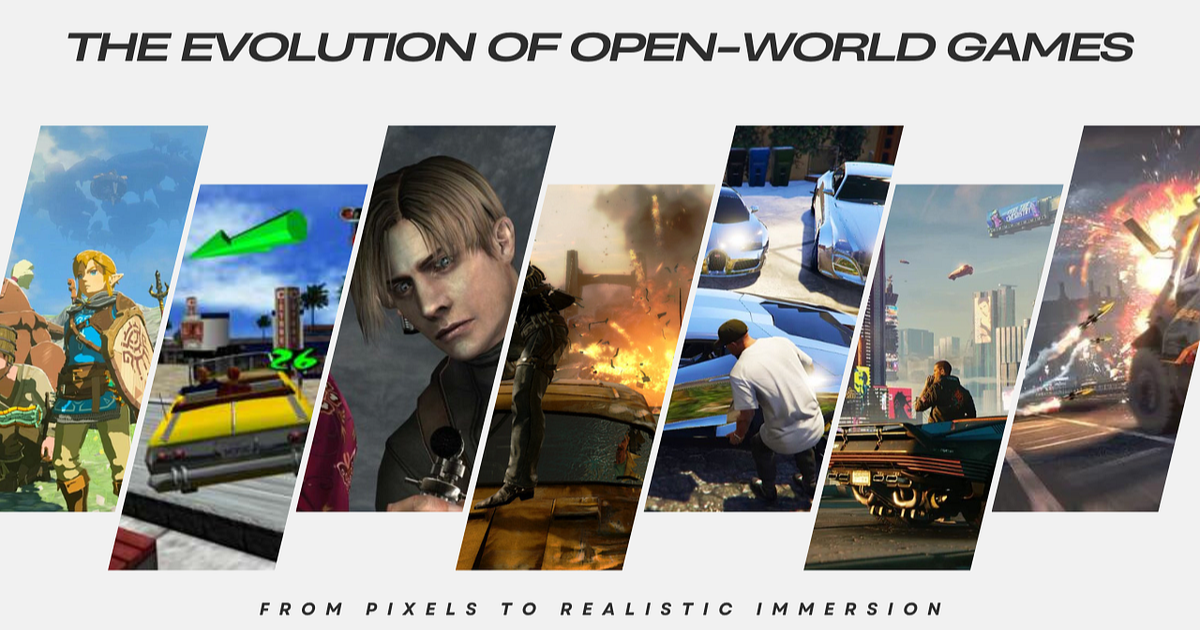
Open-world games have become the crown jewel of the gaming industry, offering players unparalleled freedom, immersion, and exploration. What began as a niche experiment has evolved into one of the most defining genres of modern gaming. From the humble days of The Legend of Zelda to the sweeping landscapes of Elden Ring and Red Dead Redemption 2, the evolution of open-world games is not just about graphics or technology—it’s about redefining how players experience stories and worlds.
The Origins of Open-World Exploration
The open-world concept dates back to the early 1980s, when games like Elite and The Legend of Zelda gave players a sense of non-linear exploration. These titles were primitive by today’s standards, yet revolutionary for their time. Instead of following a rigid path, players could choose how and where to go—an idea that would later become the backbone of the genre.
The 2000s saw a turning point with Grand Theft Auto III. Rockstar Games created a fully realized city, complete with pedestrians, cars, and missions that could be tackled in any order. For the first time, players weren’t just completing objectives—they were living in a digital world.
Technological Advancements and World-Building
The evolution of hardware played a massive role in shaping open-world design. As consoles and PCs became more powerful, developers could craft larger and more detailed environments. Games like Skyrim, Assassin’s Creed, and The Witcher 3 pushed boundaries, offering hundreds of hours of content, side quests, and dynamic NPC interactions.
Modern open-world titles rely heavily on AI systems and procedural generation. These technologies allow worlds to feel alive—NPCs have routines, wildlife behaves naturally, and weather patterns impact gameplay. Developers no longer design static environments; they create ecosystems.
Player Agency and Emergent Storytelling
Perhaps the most significant aspect of open-world games is player agency. Unlike linear campaigns, players in open-world games shape their own experiences. The choices made in dialogue, exploration, and combat can lead to unique story outcomes. Games like Cyberpunk 2077 and Elden Ring exemplify this, giving players freedom to explore multiple paths and endings.
This approach has birthed what developers call emergent storytelling—stories that arise naturally from the player’s actions rather than scripted events. Every player’s experience becomes unique, turning games into personal adventures rather than guided tours.
The Future: AI, VR, and Procedural Worlds
Looking ahead, technologies like AI-driven NPCs, virtual reality, and procedural world generation are set to revolutionize open-world gaming once again. Imagine a world that reacts intelligently to your playstyle, or AI companions that learn from your decisions. Games such as Starfield and No Man’s Sky have already introduced near-limitless exploration, hinting at a future where boundaries between player and world completely disappear.
Conclusion
The journey of open-world games mirrors the evolution of gaming itself—moving from constraint to creativity, from limitation to liberation. As technology continues to evolve, one thing remains certain: the hunger for exploration and discovery will always drive players to seek new frontiers.